
Designing Workspaces that Promote Positive Employee Wellbeing through Empathy
In this article, the conversation between workplace design consultant Steve Brewer at Burtt-Jones & Brewer, Associate Director Mbali Chaise at iPWC Ltd, led by Vanessa Champion Editor and Publisher at the Journal of Biophilic Design, at the Workspace Design Show is discussed. The trio discusses how empathetic workplace design can positively impact employee wellbeing. The article explores how understanding the individual users of a workspace is the key to building empathy, which can lead to a more positive environment. It also touches on the importance of providing users with control over their space to tailor it to their individual needs. The article also highlights the importance of designing workspaces with the senses in mind and how engaging the workforce in the design process can result in a better, more effective workspace design.
Well, let's start with clarifying what the term empathetic means.
“Empathetic: showing an ability to understand and share the feelings of another.”
So how can design play a part in what sounds like something that is behavioural?
1. What do we mean by an “empathetic workplace?”
To build true empathy in the workspace, we need to dive deep into understanding who works there, how they interact, and the impact of those interactions.
Taking time to know and understand the individual users of the workspace is at the core of crafting successfully empathetic workspaces and positive employee wellbeing.
Questionnaires, surveys, workshops and interviews, are key engagement tools for establishing a good understanding of the people that will use a workplace. By truly listening to the end user’s desired workplace experience, are we able to open up a world where we create environments tailored to support everyone.
When we take the time to gain an understanding of an office culture, it serves as more than just knowledge - it allows others to see and gain better understanding of each other, allowing us to build bridges between ourselves and our colleagues. These are the pieces of the jigsaw that all need to come together within this work environment and creating an “empathethic workplace”.
2. We often speak about human-centric design. What design elements do you include that have a direct positive impact on the wellbeing and motivation of people using the space? Can you give us examples as well?
Choice and ‘tailorism’ is what users are looking for, they crave control over the spaces they are using. A true diversity of spaces enables users to select working environments which are best for them at any given time.
The built environment is typically a fixed thing. Meaning, the windows don't open because that will mess with the air-conditioning. The lights come on, and go off. If you're lucky, you can choose how to make your own tea or coffee!
Working from home, which has increased more so over the years, where we all can open doors, turn the heating up, turn the lights on/off or angle that desktop light; has increased the desire to have the same type of flexibility and autonomy within the office workspace.
As we inch closer to having the perfect working environment at home, when in the office being able to tailor that experience down to lux levels and temperature to suit ourselves, on any given day is more challenging. There are elements that we can look at to enhance people's wellbeing and motivation when in the office.
The more choice of alternative work settings that make up a workplace i.e quiet areas/rooms and improved acoustics throughout, the more supported the workforce will feel, thus leading to higher levels of wellbeing and motivation.
However we need to ensure the implementation of these additional types of spaces are well utilised and serve a purpose. For example if there is the implementation of a wellbeing room, then also ensure the culture and the companies community supports and encourages the use of such a room! And it isn’t a token gesture of a poor quality room somewhere in the basement.
For ‘choice’ to succeed there must be a culture of trust, enabling users to utilise spaces without fear of judgement especially in relation to perceived lack of productivity.
3. Why is it important to design for the senses?
We are all individuals. And without sounding too frank, each of us has something going on. This could be from a bad Monday morning thanks to a tough weekend, to neurodiversity, to a sensitivity to lighting levels, or someone that struggles to work in a noisy office (who doesn’t, let’s be honest.)
By considering the impact of each environment on neighbouring users, by having more choice of work settings, these will go someway to being able to offer a better working environment for each of us.
Cohesively zone spaces i.e collaboration, focus, quiet for example, will also help. But people are people, so design with grey areas to allow for flexibility, this ensures that a user’s impact on their colleagues has been taken into consideration.
Also if you think about it, all our senses are constantly stimulated, wherever we are, even when we are sleeping. Nothing has changed to our physiology since our lives on the plains thousands and thousands of years ago, we are still the same “animals”. If we think we can shut ourselves off from what should be our natural state of experiencing life: fresh air, nature sound, circadian light, wood and the sensation of touching natural materials and indeed real food taste, then we are setting ourselves up for failure. Mentally and physically.
4. I’d like to talk a little about your design processes? How do you go about designing a workplace? How much engagement do you encourage from the workforce at all the different levels? Workshops; why is it important?
To build a good, solid, foundation for your design, we look to co-design with the people that are going to work within and engage with such a place..
But it’s not just about hearing what people would like in their newly designed place of work, but to help others understand that others are/will work from here too. Where tailorism can fit it, but also where compromise may be needed culturally.
Running surveys and workshops with a good cross section of staff is a given. Listening is great. But so is ensuring that people understand why, that timelines have been set, along with feedback and goal setting.
Creating an overarching vision for the new workplace is a great thing to do. It helps the moral compass to stay on target when other factors are at play.
By creating user-journeys and role-analysis from the information gathered, we can then start to discuss the types of products, furniture and changes that could be made. And then demonstrate the ratios of such items that will start to populate the office.
By co-designing the workplace, by including the people in the process of co-creation, you help them create a sense of ownership of the future space and futher buy-in to the changes that could be.
5. Some people in the audience may already be familiar with Biophilic Design, but for you, why is nature-inspired design an important one to help support employee wellbeing?
From time immemorial we have been connected to the earth, to the land, to the wind, the rain, the sun, nourishing ourselves from the abundance of fruits and seeds around us, listening to the leaves rustle, watching the birds fly in formation above our heads as they head for different climes, feel the ice cold water in the rivers, or enjoy the grass beneath our feet as we sit and talk around a fire. As a species, humanity NEEDS a connection to nature. The most obvious way is by getting outside and communing directly with nature, a regular dose of nature does wonders for mental and physical health, general wellbeing and so many other aspects of our lives.
But we spend most of our lives inside, and particularly at work. If we are at the office, many workplaces are designed using the economy principle: who are our suppliers, what can we buy bulk and let’s standardise it all so it’s cheap and quick to install.
The thing is business owners are missing a trick.
If we as humans, are surrounded just by white walls, plastics, reflective surfaces, noise, and flickering fluorescent untunable lighting, the cacophony affects us physically, the glaring light affects us physically, the bland walls affect us physically. The result is that this physical effect, changes our emotional state, raises our blood pressure, our cortisol levels, we feel stressed, and it triggers our fight or flight mode. We find it hard to concentrate, be creative and productive and I don’t need to say the impact that then has on a business’ bottom line.
What we aim to do with Biophilic Design, is to create environments where people flourish. From all the extensive research carried out (Biophilic Design is one of the most quantified, qualified and evidenced design principles), we know that introducing that “feeling” of being outside into our built environment, helps us be our best selves.
We know that “10% of employee absences can be attributed to architecture with no connection to nature” [1]. Views of nature in healthcare we know leads to 8.5% shorter stays and a quicker recovery [2].
When we have views of nature, for instance movement of waves, leaves in a breeze, fish swimming in a fish tank, our attention is held, and our cortisol levels come down. Our wellbeing is improved, and we are happier. Viewing nature is literally a pleasurable experience. In contrast, where we can see less visual richness these are processed in the “small forward portion of the visual cortex and trigger far fewer of the mu receptors, triggering less pleasurable mental reactions” [3].
We know that stress is a major cause of cardiovascular diseases as well as mental health disorders. What we seek to achieve with Biophilic Design is to create respite, relief, harmony so our brains are not distracted by sounds, views, light, textures that induce that flight or fight reaction within us that triggers the stress hormone that leads to negative mental health outcomes from psychiatric and stress/anxiety related illness. Studies show that our ability to directly access nature can alleviate feelings of stress, even our heart rate and blood pressure are at healthy levels, which further highlights the case for biophilia in the workplace [4].
[1] Terrapin Bright Green The Economics of Biophilia https://www.terrapinbrightgreen.com/reports/the-economics-of-biophilia/#the-economic-advantages-of-biophilia-in-sectors-of-society
[2] Ulrich, R. S. “View through a window may influence recovery from surgery” Science, Vol. 224. 1984.
[3] Biederman I, Vessel EA. “Perceptual pleasure and the brain.” American Scientist. 94:249–255. 2006
[4] Grahn, Patrik and Ulrika K. Stigsdotter. “The relation between perceived sensory dimensions of urban green space and stress restoration.” Elsevier Science Ltd., Journal of Landscape and Urban Planning. 264-275. 2010.

How can the circular economy help workplaces be more sustainable
Sustainability is at the forefront of almost all industries making it increasingly important that businesses understand how this agenda fits into the workplace and this is where the circular economy can play a part.
Whilst many organisations may have started looking at reducing energy consumption or switching to renewable sources, businesses must start to focus on their procurement activities and how they manage the resources in their organisations. The phrase ‘circular economy’ describes an alternative model to a linear business structure in which things are created, used for a short period and then thrown away. The circular economy offers an opportunity to transition economic activity away from the consumption of finite resources and towards a system that designs out waste and keeps products and materials in use for longer. Implementing circularity in a workplace can contribute to a business’ targets to improve environmental performance.
Making sustainable difference in the workplace
Adopting internal circular principles will only make a significant difference if you ensure that your suppliers embrace sustainability and circularity too. By mapping out clear ethical codes based on circular principles, it is much easier to communicate your expectations.
Selections could be made based not only on price and quality but also environmental impact, prioritising products made from recycled materials, leasing products for temporary use, procuring locally sourced food or implementing packaging returns policies can all make a difference. Adjusting everyday operations to introduce the concept of a circular office can also create quick wins. This can be achieved by removing single use plastics, specifying refillables for cleaning and catering products and optimising recycling opportunities and waste management.
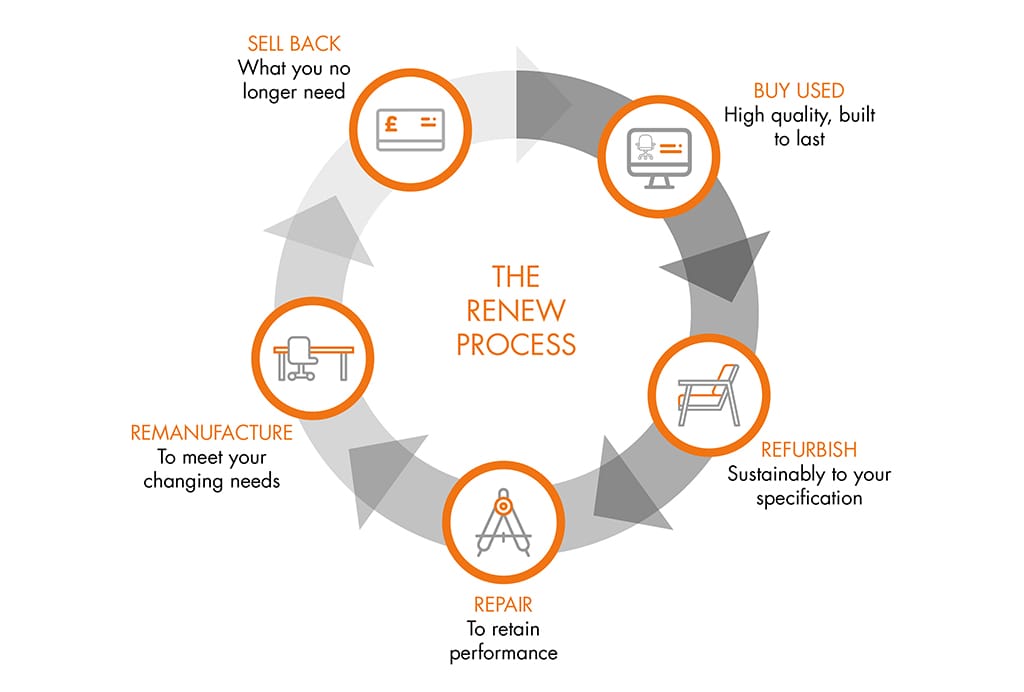
Renovation and refurbishment of office furniture and IT offers an opportunity to transform an office into a circular environment. At Crown Workspace, our award-winning renew centre is the UK’s leading facility dedicated to remanufacturing, refurbishing and repairing office furniture and IT equipment. In 2021, we processed over 27,000 pieces of IT and refurbished 19,000 items of furniture in our Renew Centre. The total carbon saving of both furniture and IT reconditioning in 2021 was 2650 CO2e (tonnes), which would be enough to power 334 homes for a whole year. Our 2022 figures have so far already exceeded this, showing continual growth and development. Rather than throwing out office furniture if it’s damaged, doesn’t fit or the style is wrong, refurbishment is a low cost circular option or rather then buying new look for sustainable refurbished items, they can be of a higher quality then an equivalent new piece.
The motivations for adopting a circular economy business model get stronger every day. Natural resources are finite and cannot be relied upon indefinitely. It’s easy to think we can leave our governing powers to change the tide, but in fact, to have any chance of turning things around, every individual needs to change their mindset. It is important to make sure that everyone in a company is working towards the same end-goal. Rewarding employees for their contributions to circularity can prevent the rejection of new processes where years of consistent practice have been changed.
The bottom line is, if we want to have a world to do business in tomorrow, we need to change the way we do business today.

"How people, places and technology come together for optimising employee experience"
By Lewis Barker, Director of Workplace Services EMEA at ServiceNow
The world of work is ever changing: People are increasingly driven by flexibility and purpose. The places we work are becoming more important than ever, people desire autonomy to carry out their work where it suits them best. And finally, the functionality of the workplace is being brought into question as technology continues to advance at a rapid pace – influencing the way we work.
And it’s these three pillars (People, Place & Technology) that — when aligned properly — will optimise employee experience, which is vital not just for talent retention and wellbeing, but also for running a smooth workplace in general. In fact, Gallup research shows a good company culture and highly engaged employees can lead to a 41% reduction in absenteeism and a 17% increase in productivity.
Put simply, businesses need to understand that improving performance in general relies on boosting the employee experience. So how can organisations set up places and technology to support and change with flexible demands?
The challenges of coming together
It’s no wonder that every company right now is assessing their approach to both people and place. The war for talent and the Great Resignation means a seamless experience wherever people work is important as ever. Enabling flexible working and work/life balance is crucial. Businesses need the tools to support this so talent can be retained and attraction improved.
In terms of place, companies now manage teams in distributed geographies and locations. Before, the physical workplace had a monopoly —employees felt they had no choice but to come into the office. But now, we must tie into the flexibility of employees. Yes, remote working has become integral to the working world, but there is still value in bringing people together in person – especially when it comes to collaboration, purpose and culture. Spaces must represent a worthwhile experience and suit the needs of the workforce for this to be acknowledged.
It’s clear employee demands are constantly changing, so technology has to be agile enough to keep up. Organisations need to put the right digital tools in place to create a complete experience and provide the data to adapt to requirements.
Using technology to optimise employee experience
Technology can be the thread between these three pillars that allows employee experience to be seamless and enables businesses to become what I like to call ‘employee experience organisations’. It's something we have achieved here at ServiceNow.
Our Workplace Service Delivery (WSD) software allowed us to glean data from our reservation tool, visitor management solution and work order management to begin to see how our spaces were being used. Now, we can look at how many people are going in and make decisions from real time information on how employees use different types of spaces through the workplace app.
In tandem with our badging data, it begins to show how our spaces will adapt to future working positions and enable us to carry out New Ways of Working pilots in different locations. We can test our plans and see whether these changes add value to the experience and productivity of our workforce.
Importantly, access to this performance data from our software allows us to adopt intentional design across our offices. No longer can you sit still and not adapt your spaces to create valuable experiences. Among organisations that create intentional places for high-level collaboration, 75% also report having high levels of team innovation. Access to informed, real-time data from WSD enables us to act accordingly and reap the rewards of productivity.
What this also means is we can implement intuitive technology that understands how to best meet the needs of employees. Namely, the Now Mobile app is designed to ensure they have the optimal experience.
As the vast majority of our employee base have been remote working since the pandemic, it can be hard to know what space is best for them. The app will be looking at different categories such ‘focus’ and ‘collaboration’ that recommends places based on purpose.
Being presented with the right environment is much more effective than having to search for it. Think of Spotify for example – ‘I want concentration music’ – the Now Mobile app works the same way. It removes hurdles so that employees can maximise productivity.
For example, when selecting collaboration, the app can show you other people in your team that have also booked into your office and will propose spaces near them. It’s another feature that aids better teamwork and purpose, with intentional options to provide a valuable experience and once again enhance productivity.
The future of the working world
Ultimately, a person should have the freedom of choice when it comes to the way they work, which has a direct influence on both place and technology. Aligning a vision between people, place and technology will have a positive impact on productivity and collaboration. That’s what has enabled ServiceNow to be an employee experience organisation.
Going forward for us, it’s about continuing to collect and build data sets for each of these pillars with agile technology to support everchanging employee demands. Always making sure people can work at their best and thrive will enable a business to do the same.
By using our technology internally to support the future of work, we can understand how it translates to helping our customers to become employee experience organisations.
To find out more about how ServiceNow can deliver solutions to enhance employee experience, visit: https://www.servicenow.com/uk/solutions/employee-experience.html