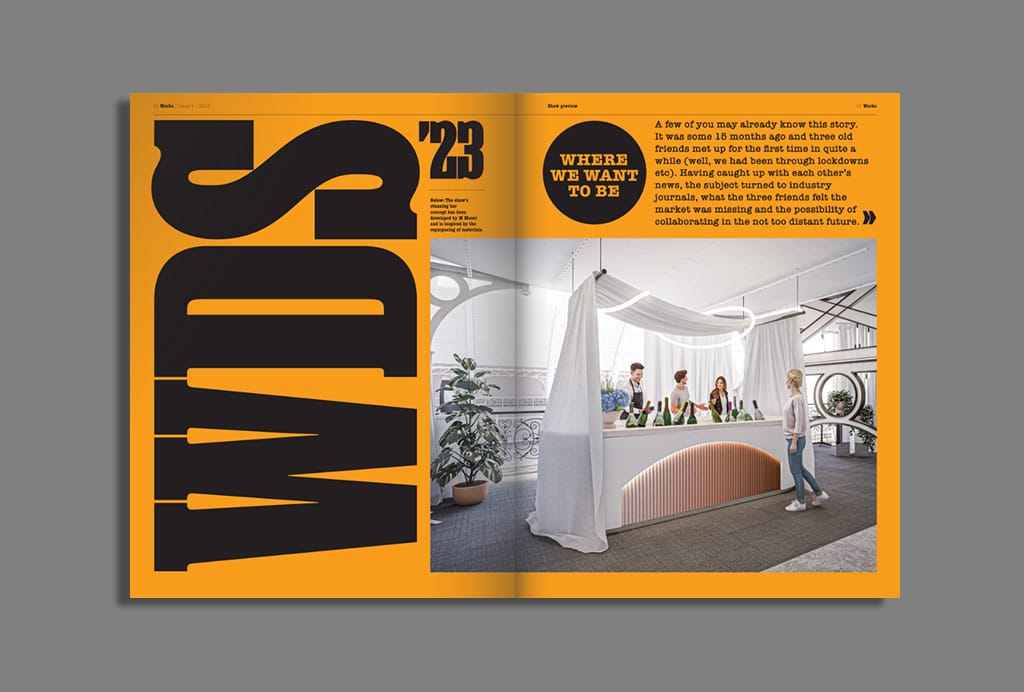
WDS Show Preview in WORKS MAGAZINE
"Returning to Islington's Business Design Centre on 27-28 Febturary, the Workspace Design Show is back, with the 2023 theme of Designation Workplace: Places Where People Want to Be.
In this ever-changing world of workplace strategy and design, there will be four different talks programmes: The Workspace Design Talks, Sustainability Works, The Occupiers Forum - The View From HQ, and The Finishes & Interiors Sector Conference."
On friends over at WORKS MAGAZINE took an in-depth look at what to expect from the 2023 edition of Workspace Design Show, from page 30-onwards in Issue 4. You can read the full article here.

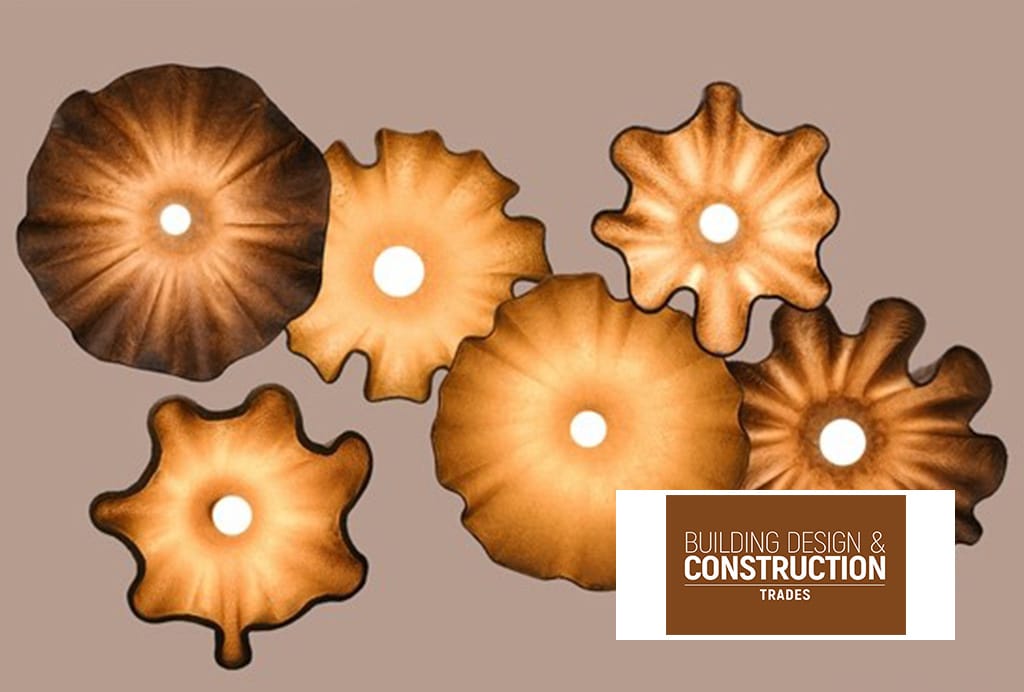
Coverage of Workspace Design Show 2023 trends featured by Building Design & Construction mMagazine
"A wide array of leading architects and designers will also be showcasing their perspectives on the latest workplace trends. A series of stunning features will be presented, including The REVIVAL Bar by Moser Associates; The Entrance ‘Destination Workplace Rebirth’ by Gensler, The Lounge: Change by Design, by BDP;
International furniture specialist, The Furniture Practice will curate this year’s Design Talks Lounge in collaboration with multidisciplinary studio Acrylicize. The main stage space will bring together key pieces from leading furniture manufacturers, including Moroso, Andreu World, Arper, Fredericia and Vitra, alongside an immersive installation celebrating material innovation within furniture and interiors."
Building, Design & Construction Magazine recently featured a writeup about the up-coming 2023 edition of Workspace Design Show. You can read the full article here.
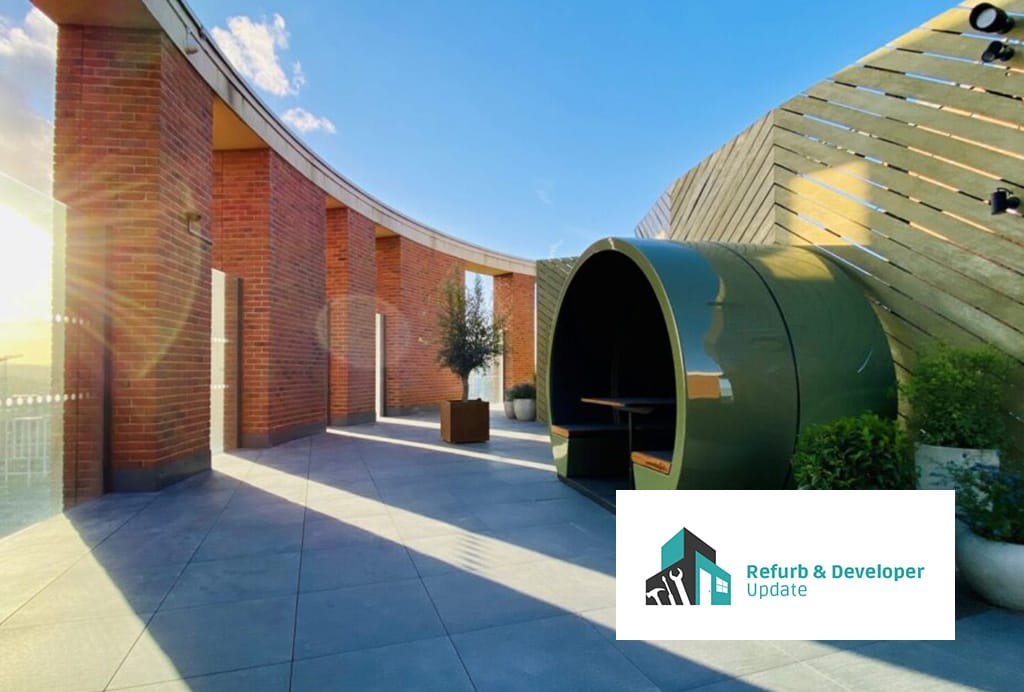
Workspace Design Show coverage by Refurb & Developer Update
"Workspace Design Show is showcasing a vast range of products that aid privacy and sound control. Amongst these are award winning firm The Meeting Pod Company, known for their commercial and domestic, indoor and outdoor meeting pods. Mute, meanwhile, will be displaying various solutions to regain focus and allow conversations to flow."
Thank you to the kind folks over at Refurb & Developer Update for featuring the 2023 edition of Workspace Design Show last month. You can read the full article here.
SpecFinish's recent feature on Workspace Design Show 2023
"Workspace Design Show 2023 is bringing together the latest innovations and trends under one roof, with an extensive range of unmissable products."
Our friends over at SpecFinish recently covered the 2023 edition of Workspace Design Show. Read the full article here.
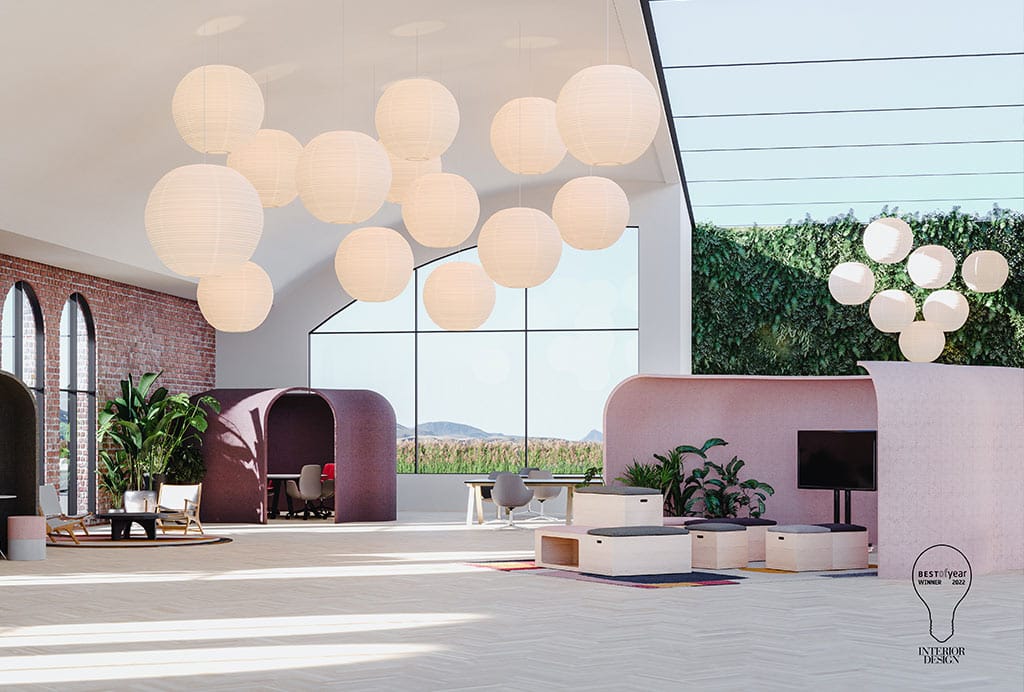
Workspace Design Show set to showcase top workplace trends for 2023
From acoustics to furniture to flooring and fabrics, Workspace Design Show is the perfect place to discover the workplace trends for 2023. The show, taking place between 27- 28 February 2023, brings you an extensive exhibitor line-up where the workplace interiors community can gather and celebrate the latest in office innovation. With many new as well as returning exhibitors, London’s Business Design Centre will be the place to explore cutting-edge workspace solutions.
Workspaces are increasingly requiring multifunctional products. Furniture designer Pedrali will be exhibiting the multifunctional BuddyHub Desk, a functional and efficient workstation where users can concentrate and isolate, to partition open spaces and create collaborative and meeting areas. Spacestor will be launching their newest product development, Arcadia, a space-making toolkit for designers which brings the New Landscape for Work.
RS Barcelona will showcase other fully flexible products, among them its ‘you and me’ ping pong table which caters for the recent trend ‘microbreaks’ which are proven to increase productivity. With mental and physical well-being at the forefront of workplace design, Technogym will be showcasing elements of its product ecosystem: connected smart equipment for end-user access wellness. ‘Personal Line’, for example, was created using over three decades of biomechanical experience and feedback, combined with the design skills of iconic Italian designer Antonio Citterio.
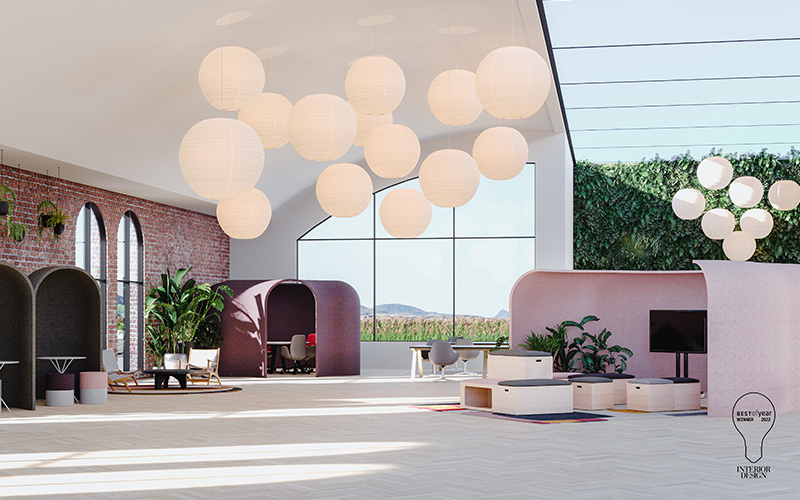
Workspace Design Show has every surface covered from flooring to fabrics, which are increasingly used to define different spaces within an office floorplate. Flooring specialists Tarkett and Strata Tiles will both be exhibiting, demonstrating their latest surface solutions. Exploring the importance of colour and texture through fabrics is Kvadrat, a well-renowned textiles company, which produces high-performance, design textiles, rugs, acoustic and window covering solutions for both commercial and residential uses. BIOHM will present the bio materials exhibition, with biological systems at the heart of its inspiration.
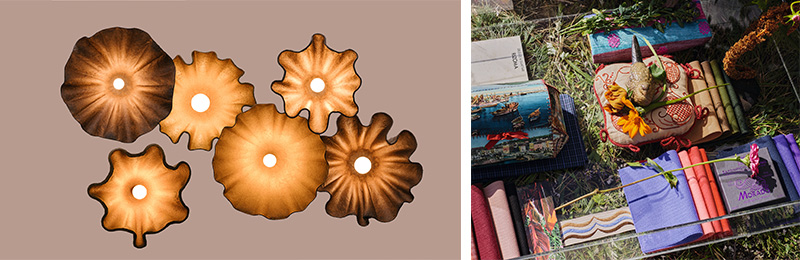
Workspace Design Show is showcasing a vast range of products that aid privacy and sound control. Amongst these are award winning firm The Meeting Pod Company, known for their commercial and domestic, indoor and outdoor meeting pods. Mute, meanwhile, will be displaying various solutions to regain focus and allow conversations to flow. Making a return to the show are leaders in sustainable and acoustic finishes, Woven Image, who will be demonstrating the importance of ceilings in acoustic control. Fora Form, one of Scandinavia's largest furniture manufacturers for social areas will also be exhibiting.
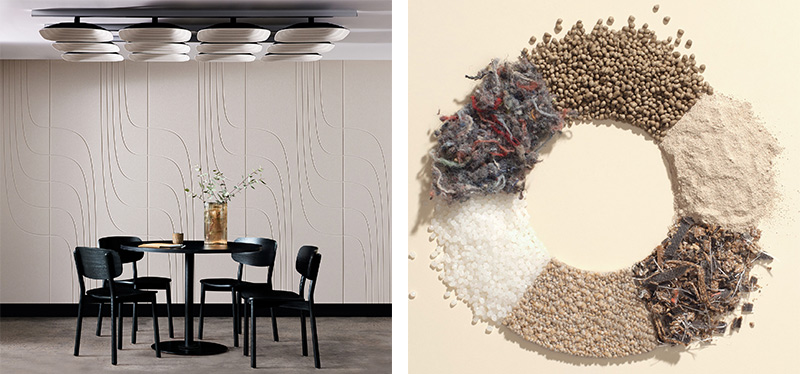
The event will also host some of the industry’s leading architectural lighting specialists, demonstrating the move away from harsh office lighting towards more human-centric solutions. Collaborators include FUTURE Designs, sponsors of the bar area. This UK-based firm specialises in quality bespoke lighting solutions and has recently gained the Carbon Careful sustainable accreditation. Lighting exhibitors include Erco which has a whole portfolio based entirely on LED technology and Delta Light, recognised throughout the world for its subtle blend of ambiance, elegance, functionality, and design, both in interior and exterior lighting. The Indoor and Outdoor intelligent lighting specialist, iGuzzini will also be exhibiting their latest products.
A wide array of leading architects and designers will also be showcasing their perspectives on the latest workplace trends. A series of stunning features will be presented, including The REVIVAL Bar by Moser Associates; The Entrance ‘Destination Workplace Rebirth’ by Gensler, The Lounge: Change by Design, by BDP;
International furniture specialist, The Furniture Practice will curate this year's Design Talks Lounge in collaboration with multidisciplinary studio Acrylicize. The main stage space will bring together key pieces from leading furniture manufacturers, including Moroso, Andreu World, Arper, Fredericia and Vitra, alongside an immersive installation celebrating material innovation within furniture and interiors.
Workspace Design Show 2023 is bringing together the latest innovations and trends under one roof, with an extensive range of unmissable products.
Coverage of WDS speaker line-up and Talks in Dezeen
Thank you to our media partners over at Dezeen for their recent coverage of programme of talks, which can be read in part below:
"Annual trade fair Workspace Design Show returns to London for its second edition, which will see design experts debate topics such as optimising real estate with flexible design, employee wellbeing and designing the future workspace experience.
The trade show includes a programme of talks, following the theme Destination Workplace: Places Where People Want to Be, in which discussions will address topics such as changing environments, hybrid working and designing workplaces that will attract employees.
Speakers at the Workspace Design Talks include partner at Foster + Partners, Grant Kanik; head of interiors at Heatherwick Studio, Charlotte McCarthy; design leader of real estate services at Ernst & Young, Lola Hoya; founding partner and president at PLP, Lee Polisano; and founder and CEO of The Society of British and International Interior Design, Vanessa Brady."
Click here to read the article in full.
How can the circular economy help workplaces be more sustainable
Sustainability is at the forefront of almost all industries making it increasingly important that businesses understand how this agenda fits into the workplace and this is where the circular economy can play a part.
Whilst many organisations may have started looking at reducing energy consumption or switching to renewable sources, businesses must start to focus on their procurement activities and how they manage the resources in their organisations. The phrase ‘circular economy’ describes an alternative model to a linear business structure in which things are created, used for a short period and then thrown away. The circular economy offers an opportunity to transition economic activity away from the consumption of finite resources and towards a system that designs out waste and keeps products and materials in use for longer. Implementing circularity in a workplace can contribute to a business’ targets to improve environmental performance.
Making sustainable difference in the workplace
Adopting internal circular principles will only make a significant difference if you ensure that your suppliers embrace sustainability and circularity too. By mapping out clear ethical codes based on circular principles, it is much easier to communicate your expectations.
Selections could be made based not only on price and quality but also environmental impact, prioritising products made from recycled materials, leasing products for temporary use, procuring locally sourced food or implementing packaging returns policies can all make a difference. Adjusting everyday operations to introduce the concept of a circular office can also create quick wins. This can be achieved by removing single use plastics, specifying refillables for cleaning and catering products and optimising recycling opportunities and waste management.
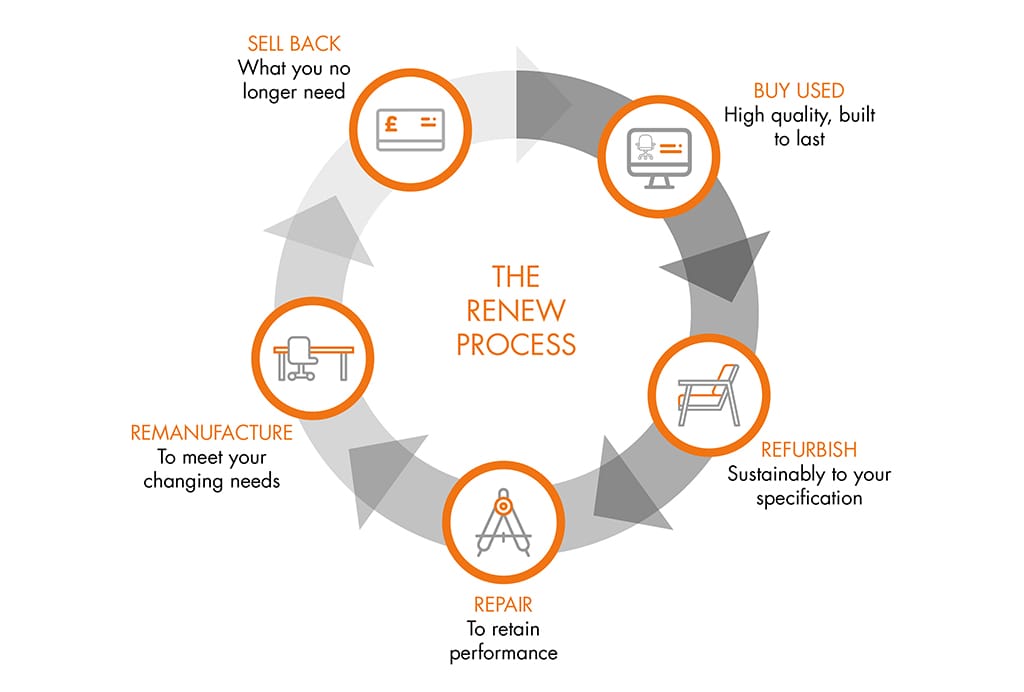
Renovation and refurbishment of office furniture and IT offers an opportunity to transform an office into a circular environment. At Crown Workspace, our award-winning renew centre is the UK’s leading facility dedicated to remanufacturing, refurbishing and repairing office furniture and IT equipment. In 2021, we processed over 27,000 pieces of IT and refurbished 19,000 items of furniture in our Renew Centre. The total carbon saving of both furniture and IT reconditioning in 2021 was 2650 CO2e (tonnes), which would be enough to power 334 homes for a whole year. Our 2022 figures have so far already exceeded this, showing continual growth and development. Rather than throwing out office furniture if it’s damaged, doesn’t fit or the style is wrong, refurbishment is a low cost circular option or rather then buying new look for sustainable refurbished items, they can be of a higher quality then an equivalent new piece.
The motivations for adopting a circular economy business model get stronger every day. Natural resources are finite and cannot be relied upon indefinitely. It’s easy to think we can leave our governing powers to change the tide, but in fact, to have any chance of turning things around, every individual needs to change their mindset. It is important to make sure that everyone in a company is working towards the same end-goal. Rewarding employees for their contributions to circularity can prevent the rejection of new processes where years of consistent practice have been changed.
The bottom line is, if we want to have a world to do business in tomorrow, we need to change the way we do business today.

"How people, places and technology come together for optimising employee experience"
By Lewis Barker, Director of Workplace Services EMEA at ServiceNow
The world of work is ever changing: People are increasingly driven by flexibility and purpose. The places we work are becoming more important than ever, people desire autonomy to carry out their work where it suits them best. And finally, the functionality of the workplace is being brought into question as technology continues to advance at a rapid pace – influencing the way we work.
And it’s these three pillars (People, Place & Technology) that — when aligned properly — will optimise employee experience, which is vital not just for talent retention and wellbeing, but also for running a smooth workplace in general. In fact, Gallup research shows a good company culture and highly engaged employees can lead to a 41% reduction in absenteeism and a 17% increase in productivity.
Put simply, businesses need to understand that improving performance in general relies on boosting the employee experience. So how can organisations set up places and technology to support and change with flexible demands?
The challenges of coming together
It’s no wonder that every company right now is assessing their approach to both people and place. The war for talent and the Great Resignation means a seamless experience wherever people work is important as ever. Enabling flexible working and work/life balance is crucial. Businesses need the tools to support this so talent can be retained and attraction improved.
In terms of place, companies now manage teams in distributed geographies and locations. Before, the physical workplace had a monopoly —employees felt they had no choice but to come into the office. But now, we must tie into the flexibility of employees. Yes, remote working has become integral to the working world, but there is still value in bringing people together in person – especially when it comes to collaboration, purpose and culture. Spaces must represent a worthwhile experience and suit the needs of the workforce for this to be acknowledged.
It’s clear employee demands are constantly changing, so technology has to be agile enough to keep up. Organisations need to put the right digital tools in place to create a complete experience and provide the data to adapt to requirements.
Using technology to optimise employee experience
Technology can be the thread between these three pillars that allows employee experience to be seamless and enables businesses to become what I like to call ‘employee experience organisations’. It's something we have achieved here at ServiceNow.
Our Workplace Service Delivery (WSD) software allowed us to glean data from our reservation tool, visitor management solution and work order management to begin to see how our spaces were being used. Now, we can look at how many people are going in and make decisions from real time information on how employees use different types of spaces through the workplace app.
In tandem with our badging data, it begins to show how our spaces will adapt to future working positions and enable us to carry out New Ways of Working pilots in different locations. We can test our plans and see whether these changes add value to the experience and productivity of our workforce.
Importantly, access to this performance data from our software allows us to adopt intentional design across our offices. No longer can you sit still and not adapt your spaces to create valuable experiences. Among organisations that create intentional places for high-level collaboration, 75% also report having high levels of team innovation. Access to informed, real-time data from WSD enables us to act accordingly and reap the rewards of productivity.
What this also means is we can implement intuitive technology that understands how to best meet the needs of employees. Namely, the Now Mobile app is designed to ensure they have the optimal experience.
As the vast majority of our employee base have been remote working since the pandemic, it can be hard to know what space is best for them. The app will be looking at different categories such ‘focus’ and ‘collaboration’ that recommends places based on purpose.
Being presented with the right environment is much more effective than having to search for it. Think of Spotify for example – ‘I want concentration music’ – the Now Mobile app works the same way. It removes hurdles so that employees can maximise productivity.
For example, when selecting collaboration, the app can show you other people in your team that have also booked into your office and will propose spaces near them. It’s another feature that aids better teamwork and purpose, with intentional options to provide a valuable experience and once again enhance productivity.
The future of the working world
Ultimately, a person should have the freedom of choice when it comes to the way they work, which has a direct influence on both place and technology. Aligning a vision between people, place and technology will have a positive impact on productivity and collaboration. That’s what has enabled ServiceNow to be an employee experience organisation.
Going forward for us, it’s about continuing to collect and build data sets for each of these pillars with agile technology to support everchanging employee demands. Always making sure people can work at their best and thrive will enable a business to do the same.
By using our technology internally to support the future of work, we can understand how it translates to helping our customers to become employee experience organisations.
To find out more about how ServiceNow can deliver solutions to enhance employee experience, visit: https://www.servicenow.com/uk/solutions/employee-experience.html
Speakers Q&A: How have you been using sustainable products and implementing sustainable designs in their offices?
Cristiano Testi, Principal Director at tp bennett
The embodied carbon of materials contributes to at least 40% of a building’s total carbon footprint – for offices this can be as much as 60-70% (World Green Building Council, 2021), meaning that nearly two thirds of its carbon footprint can be ‘blown’ before the first user switches on the first light.
As an international design practice, the materials we specify are both our most significant environmental impact, and our greatest opportunity to achieve positive change!
However, true “sustainability” should consider more than just environmental factors – and must also focus upon social interfaces; most notably for those working in higher-risk supply chain manufacturing processes.
To bring together all elements of sustainability, tp bennett has developed AD-Lib; a responsible sourcing product library, enabling our colleagues to make informed decisions when specifying materials.
Claire Henderson, Inclusive Design Lead, Workplace Design at HMRC
HMRC, as a UK Government body, has a responsibility to ensure we are a considerate client and as such our Locations Programme has very much driven a sustainable agenda from day 1, local procurement is always our preferred route, we seek innovative products made from recycled materials as well as longer lifecycle products to reduce the need to regularly replace. This is also something we ensure all of our suppliers have embedded in their processes so that it flows down the supply chain and hopefully drives a change throughout the industry.
Consideration to how we ensure the ongoing operation of our buildings is sustainable is also high on our agenda, for example how we can drive better waste management and user behaviours around recycling through design as well as thinking about how our building management systems can drive energy efficiencies.
Paula Rowntree, Head of Workplace Design at Lloyds Banking Group
Sustainability is a core of our strategy as a business so how we design with sustainability at the heart is front and centre for us. Our supply chain is encouraged to bring new, innovative products to our attention and we regularly run an Innovation Dragons Den with our Sustainability team to encourage companies to share with us what they are doing – clearly this is a space where innovation and creativity is driving lots of fantastic initiatives to improve the basics of heating and lighting systems as well as innovation in furniture and biophilia. Driving to net zero is a minimum standard we are setting ourselves.
Natasha Hewlett, Senior Project Designer at Peldon Rose
As designers we should be questioning every product choice we make, designing out waste wherever we can and thinking about the entire life cycle of each and every specified item. Sustainable design also encapsulates how flexible and adaptable a workspace can be as well as what material is chosen for a worktop, for example. Reducing waste (and therefore carbon) is important on any fit out and there are many ways this can be achieved - from flooring take back schemes to furniture reuse/rental offerings. Sustainability should be on the forefront of every supplier and installers mind too, connecting the entire chain from design to build and then throughout the entire products life cycle.
Naomi Sakomoto, Senior Associate, Gensler
As architects and designers, we have a mandate to inspire and deliver stepwise change in response to the climate crisis. The success of our 2030 commitments relies on the work we design and deliver today. Each of us must begin by upskilling ourselves and recalibrating our concept of good design in the context of the environmental challenge we face. We must collaborate with our clients to establish audacious goals that tell a unique story about the site, the values, and their brand. We must collaborate across the value chain to bring this vision to reality, from consultants and manufacturers to start-ups and universities, to bring new technologies to market. Every project is an opportunity to pivot from architecture that does less harm, to architecture that restores the environment around us.
Speakers Q&A: What type of products are you looking forward to seeing at the Workspace Design Show?
Claire Henderson, Inclusive Design Lead, Workplace Design at HMRC
Given the change in the way we use the office now I’m keen to see some modular products that help us create collaborative spaces whilst protecting future flexibility, and of course, being inclusive for all. The increased focus on neurodiversity across society also offers designers/manufacturers the chance to show something innovative and I would be really keen to hear how they have sought and built on user feedback to develop products which truly offer something different.
Technology is also a key interest for me, how can we use that to support all building users to have the best experience possible?
Lewis Barker, Director, Workplace Services EMEA at ServiceNow
Data capture technology – the workplace needs good and accurate data as we test and iterate designs within our spaces. There is a lot of experimentation that needs to happen.
Employee Experience engagement platforms – Ensuring a seamless experience when going to a physical workplace is important. If you take away the friction with booking spaces, catering etc then it is one less hurdle for your employee base not to interact with at the workplace.